EURIE Istanbul 2027 Exhibition Stand Guide
EURIE Istanbul 2027, the Eurasia Higher Education Summit, will take place from 6–8 April 2027 at Istanbul Lütfi Kırdar International Convention and Exhibition Centre (ICEC) in Istanbul.
EURIE combines an international higher education exhibition with a conference programme focused on academic collaboration, internationalization, student mobility, recruitment, research partnerships and higher education management.
The event brings together universities, education ministries, public agencies, international education associations, recruitment organizations, service providers and professionals responsible for international relations and academic development.
For exhibitors, the stand is more than a place to distribute brochures. It should communicate the institution’s identity, make programmes and partnership opportunities understandable and provide a professional environment for scheduled and spontaneous meetings.
Country and group pavilions face an additional challenge: they must create a strong shared identity while giving every participating university or organization sufficient visibility.
Why EURIE Istanbul matters
EURIE positions itself as a meeting point connecting the higher education sector in Eurasia with the wider international academic community. Its exhibition and conference formats support networking, institutional partnerships, student and staff mobility, joint research and international education services.
The official EURIE 2026 prospectus reported the following results for the 2025 edition:
More than 2,800 attendees
178 exhibitors
320 participating organizations
65 represented countries
156 speakers
52 conference sessions
These are previous-edition results rather than forecasts for 2027. They nevertheless demonstrate the international reach of the summit and the variety of institutions competing for attention.
The visitor profile includes university presidents, rectors, senior administrators, international-office directors, mobility specialists, recruitment teams, government representatives, associations, researchers, education consultants and technology providers.
Many participants arrive with specific partnership objectives. They may be looking for exchange agreements, joint programmes, research collaboration, recruitment representatives, government relationships or access to particular regional markets.
A successful EURIE stand should therefore help visitors identify the institution’s priorities quickly and connect with the correct representative without navigating an overloaded display.
Stand design priorities for universities and education organizations
Establish a clear institutional identity
University stands often contain many competing messages: rankings, faculties, campuses, programmes, research achievements, scholarship opportunities and international partnerships.
Trying to present everything with equal prominence creates visual noise. The stand should begin with one clear institutional identity supported by a small number of strategic messages.
From the aisle, visitors should be able to recognize:
The institution or pavilion
Its country or region
Its primary academic or partnership focus
The type of conversation available at the stand
Detailed programme information can then be presented through brochures, screens, consultation tables and digital resources.
Design around commercial and academic objectives
A stand created for student recruitment requires a different arrangement from one focused on institutional partnerships.
Recruitment-oriented exhibitors may need open information counters, accessible programme displays and space for frequent short conversations. Universities seeking joint degrees, exchange agreements or research partnerships may require quieter tables and semi-private meeting areas.
Before starting the design, exhibitors should define their principal objectives, such as:
Recruiting international students
Meeting potential academic partners
Developing exchange programmes
Presenting research capabilities
Promoting scholarship opportunities
Representing a national education system
Supporting an education ministry or public agency
Introducing education technology or student services
These objectives should determine the visitor journey and the balance between presentation, consultation and meeting space.
Avoid creating a brochure warehouse
Printed material remains useful at education exhibitions, but large quantities of brochures can make a stand feel cluttered and difficult to manage.
A curated display should introduce the most relevant information while concealed storage holds additional copies. Programmes can be separated by academic level, subject, audience or language.
QR codes and digital enquiry forms can provide access to detailed information without requiring every visitor to carry a complete prospectus. Digital resources should complement personal discussion rather than replacing it.
Support multilingual communication
International exhibitors may receive visitors who speak different languages and represent different education systems. Information hierarchy should remain understandable even when detailed explanations require assistance from a representative.
Short headings, programme categories, maps and carefully selected icons can support orientation. Screens may provide multilingual content, but changing slides should remain slow enough for visitors to understand the message.
Staff positions should also be planned so visitors can easily identify who can answer academic, recruitment, partnership or government-related questions.
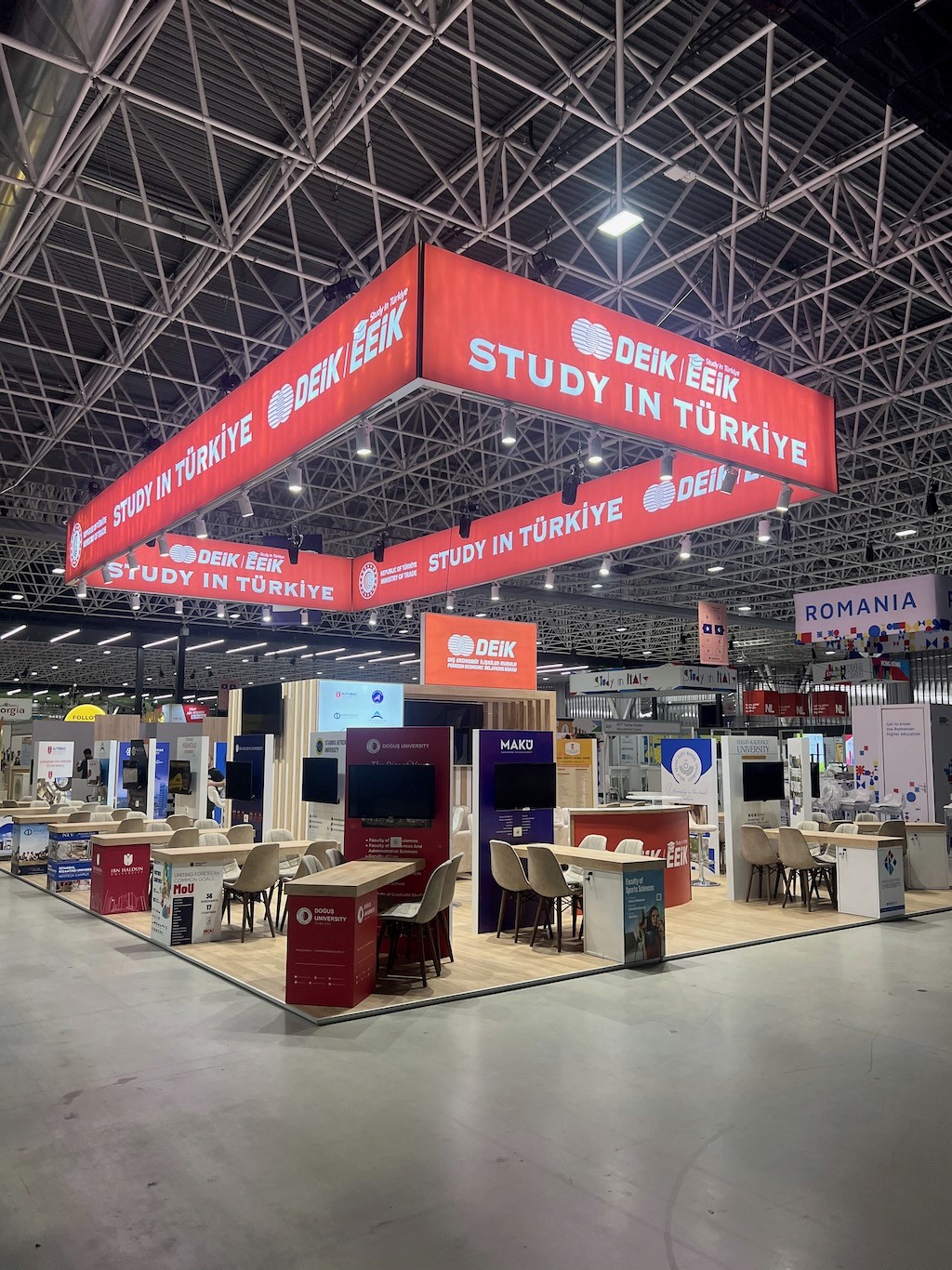
Designing country and group pavilions
Country pavilions can create stronger visibility than a collection of unrelated university booths, but the shared architecture must balance national identity with institutional independence.
The pavilion should communicate a clear collective message while giving each participating organization a recognizable position.
A practical pavilion hierarchy may include:
A high-level country or programme identity
A central welcome and information point
Clearly identified university stations
Shared digital or presentation content
Open networking areas
Semi-private partnership tables
Central storage and hospitality
Space for ministry or delegation representatives
The architectural language should connect the participants without making every station identical. A shared material palette, overhead structure or graphic system can create unity, while individual counters, screens or branded panels identify each institution.
Circulation is particularly important. Visitors should be able to enter from more than one direction, understand the pavilion layout and reach a specific university without crossing private meetings.
For delegations containing many institutions, a digital directory or simple physical map can help visitors locate the right representative.
Presenting universities, programmes and partnerships effectively
Higher education offers are largely intangible. Unlike a product exhibition, visitors cannot physically inspect a degree programme, research partnership or student experience.
The stand must translate those offers into understandable visual and conversational formats.
Campus photography can provide context, while maps explain location and international connections. Screens can present student experiences, research facilities, collaborative projects and campus environments.
However, the stand should not depend entirely on promotional videos. Visitors need a clear explanation of what makes the institution relevant to them.
Useful presentation methods include:
Programme and faculty overview panels
Regional and international partnership maps
Research and innovation case studies
Scholarship and mobility information
Campus photography and short videos
Alumni and student outcomes
Joint-programme examples
Digital enquiry and appointment systems
QR access to programme information
Displays explaining application or partnership processes
For institutions seeking academic partners, evidence of existing international collaboration may be more persuasive than general lifestyle imagery.
Country pavilions can also use a shared screen or presentation area for scheduled institutional introductions, provided it does not dominate neighbouring meetings or create excessive noise.
Meetings, hospitality and visitor flow
EURIE combines an exhibition with a conference programme, creating periods of concentrated activity between sessions. Stands must handle sudden increases in visitor traffic while protecting scheduled meetings.
Different meeting formats may be required:
Standing counters for quick introductions
Open tables for programme discussions
Consultation points for students or agents
Semi-private seating for partnership meetings
A private room for senior delegations
Shared pavilion lounges for institutional networking
Furniture should not block the entrance or reduce visibility. Meeting tables placed too close to the aisle can expose confidential discussions and make seated visitors feel uncomfortable.
A reception point should guide visitors without becoming a barrier. For country pavilions, the reception team should be able to direct visitors to participating institutions quickly.
Hospitality should remain compact and professionally managed. Storage is needed for refreshments, personal belongings, brochures, gifts, technical equipment and replacement materials.
Acoustic control also matters. Soft finishes, partially enclosed meeting areas and thoughtful speaker positioning can improve conversation quality in a busy exhibition hall.
What to send your stand contractor
A useful design and reliable quotation require a complete brief. Universities, agencies and pavilion organizers should provide:
Hall plan and stand location
Confirmed stand dimensions
Stand type and number of open sides
Organizer’s latest exhibitor documentation
Maximum permitted construction height
Institution or pavilion brand guidelines
Approved logos and graphic files
Number of participating institutions
Hierarchy between country and university branding
Primary exhibition objectives
Programme and partnership priorities
Required languages
Brochure quantities and display requirements
Screen and audiovisual requirements
Presentation or speaking requirements
Meeting formats and seating capacity
Delegation and staffing numbers
Reception and information-desk requirements
Hospitality requirements
Storage requirements
Accessibility considerations
Furniture preferences
Previous pavilion or stand photographs
Preferred architectural style
Available budget range
For country pavilions, the organizer should also provide a final participant list and clarify what every institution receives. Late changes to participant numbers can affect counters, graphics, electrical services, storage and visitor circulation.
Graphic content should be finalized early. Collecting correctly formatted material from several universities often takes longer than producing the physical pavilion.
Why turnkey local execution matters in Istanbul
International universities and pavilion organizers may coordinate several suppliers, including a design agency, local fabricator, graphic producer, audiovisual provider, freight company and venue-service team.
When responsibility is divided, information can be lost between the institution, pavilion organizer and installation team. Graphic files may arrive in different formats, furniture requirements may change and participating universities may submit content at different times.
A turnkey Istanbul contractor can coordinate concept development, technical drawings, production, graphics, transport, installation, venue communication, on-site adjustments and dismantling through one project workflow.
Local production also supports faster checking of finishes, printed graphics and institutional branding before installation. During build-up, an Istanbul-based team can respond directly when participant names, counter allocations or presentation requirements change.
This coordination is particularly valuable for country pavilions, where one change can affect several participating institutions.
Planning your stand or country pavilion for EURIE Istanbul 2027? Maher Design supports universities, public organizations and international delegations with concept development, production, installation and on-site project management. Discuss your requirements.
Recommended planning timeline for EURIE 2027
Five to seven months before the summit
Confirm the stand or pavilion location, commercial objectives, approximate budget and project responsibility. For group participation, begin identifying universities and public organizations that will join the pavilion.
Three to five months before
Develop the architectural concept, institutional hierarchy and visitor journey. Determine the required counters, meeting spaces, screens, storage and hospitality areas.
Country pavilion organizers should establish clear submission requirements for participating institutions at this stage.
Eight to twelve weeks before
Approve the stand design, materials, furniture, lighting and audiovisual systems. Confirm the contractor and complete technical drawings.
Collect approved university logos, programme information, campus imagery and partnership content.
Four to eight weeks before
Complete organizer submissions, graphic layouts, electrical planning and presentation schedules. Confirm the final delegation list and assign meeting or information points.
Final three to four weeks
Release all approved graphics, finish production and review the installation programme. Confirm on-site representatives and establish who can approve changes during build-up.
The official EURIE 2027 schedule currently lists 5 April for registration, exhibitor setup and optional campus visits, followed by the summit from 6–8 April. Exhibitors should verify the final setup timetable and access instructions with the organizer before confirming transport and installation arrangements.
ICEC and organizer considerations
EURIE 2027 will be held at Istanbul Lütfi Kırdar International Convention and Exhibition Centre in Istanbul’s Congress Valley, close to Taksim Square and major hotels.
Before finalizing the design, exhibitors and contractors should review the latest EURIE documentation and the technical conditions applicable to the assigned ICEC exhibition area.
Items requiring confirmation may include:
Permitted stand height
Technical-approval requirements
Build-up and dismantling periods
Loading and vehicle access
Fire-safety documentation
Electrical connections
Internet and network services
Rigging permissions
Floor protection and raised-floor requirements
Audiovisual and sound restrictions
Catering permissions
Storage limitations
Accessibility requirements
Rules for distributing materials outside the stand
Registration and contractor-access procedures
The organizer’s 2026 prospectus offered standard individual stands and larger country or group pavilion formats. Exhibitors should not assume that previous package dimensions or inclusions automatically apply to 2027. The current participation offer and technical documentation should remain the controlling references.
Because setup time may be limited, custom pavilion elements and graphics should be completed and tested before arriving at the venue.
What makes a strong stand at EURIE?
A strong EURIE stand makes an institution’s international priorities easy to understand.
Visitors should be able to identify the university, country or education organization from the aisle and quickly determine whether it offers relevant programmes, partnership opportunities, scholarships, research capabilities or services.
The most effective stands create a clear sequence:
Recognition from the aisle
A concise institutional introduction
Access to relevant information
Conversation with the appropriate representative
A comfortable setting for detailed discussion
Simple digital follow-up after the summit
Country pavilions should achieve the same sequence at two levels: first for the country or education system, then for each participating institution.
The stand should feel professional, open and internationally credible. Architecture, graphics and digital content should support conversations rather than compete for attention.
Success should not be measured by the number of brochures displayed. The more valuable outcome is helping relevant visitors reach the right representative and begin a productive institutional relationship.
Maher Design services for EURIE Istanbul
Maher Design provides exhibition stand and country pavilion services for universities, education organizations and international delegations exhibiting in Istanbul, including:
Stand and pavilion concept design
3D visualisation
Technical drawings
Custom production
Country pavilion planning
Participant and counter coordination
Graphics and institutional branding
Lighting and audiovisual coordination
Presentation-area integration
Furniture and hospitality
Transport and installation
Venue coordination
On-site project management
Dismantling
Based in Istanbul, Maher Design combines bespoke exhibition design with direct local production and on-site delivery.
Start planning your EURIE Istanbul 2027 stand
To begin planning, send the stand dimensions, hall plan, participant list, institutional objectives, branding files, programme information, preferred meeting formats, previous stand photographs and available budget range.
For country pavilions, include the proposed number of participating universities and the facilities each institution requires.
These details allow the design team to evaluate the pavilion hierarchy, visitor flow, meeting capacity, information displays and technical scope before preparing the concept and quotation.